Project P.I.T.T. gameplay — how the loop works
Project P.I.T.T. is a first-person physics sandbox with one joke that carries the whole game: you are an intern at a company whose only job is to make rubber ducks and feed them to a corporate void. The loop is simple on paper, and the depth is in the contraptions. Here's how it actually plays, no marketing fluff.
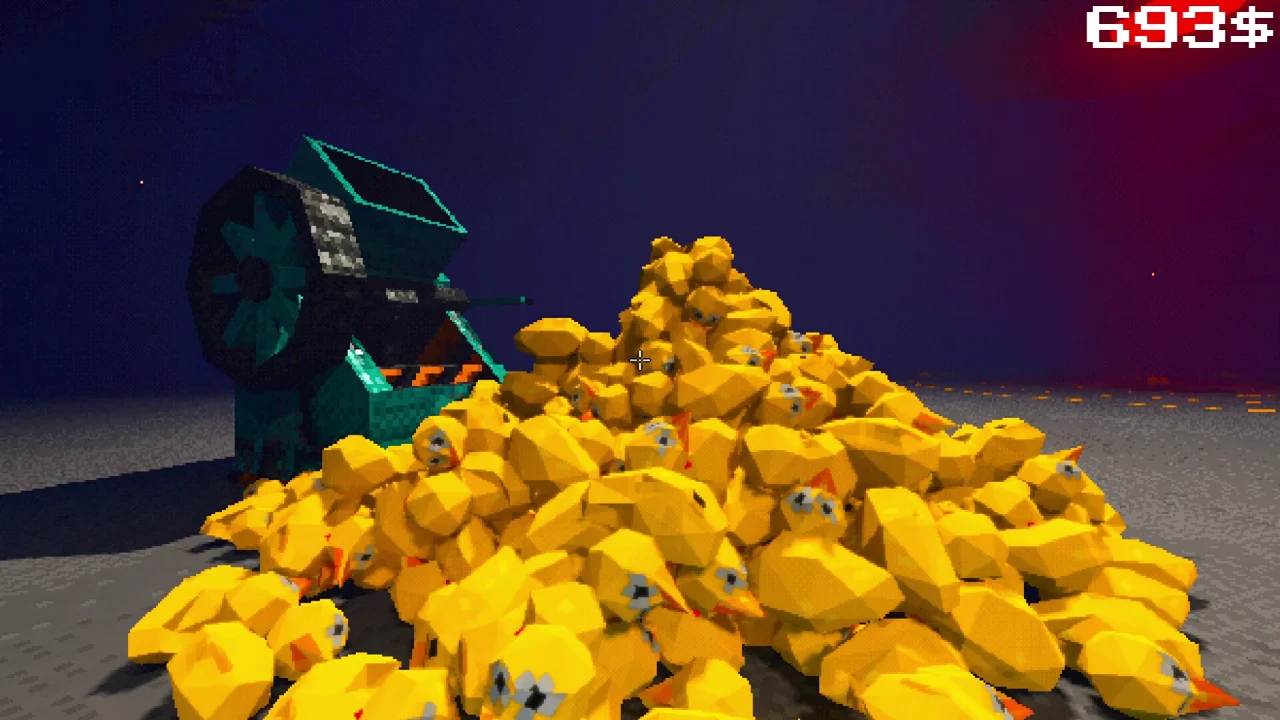
The core loop, in 4 steps
- Craft. You have a workstation. You make rubber ducks out of basic materials — the recipe is simple, the execution is fiddly in the satisfying way physics sandboxes tend to be.
- Build a contraption. This is the actual game. You rig up pipes, conveyor belts, ramps, anything in the physics sandbox, to move the duck from your workstation to the Maw without dropping it (or to drop it on purpose if that's the joke).
- Feed the Maw. The Maw is the corporate void. Ducks go in. It's the only thing the game wants from you, and it's the visual punchline of the whole thing.
- Combo for profit. Chaining ducks in quick succession triggers combos. The combos are what the game measures you on — single ducks are fine, sustained delivery chains are the real score.
The whole gameplay loop fits in those four steps, repeated. There's no second mode, no boss fight, no second area. What changes is the contraption complexity, and the fact that the Maw grows hungrier and larger as you feed it, which is the only real progression in the game.
What makes the loop interesting
- Contraption engineering. The physics sandbox is the only thing in the game you can't rush. A simple ramp gets the first duck in; the twentieth duck takes a three-stage contraption with backup plans when the physics decides to misbehave.
- Combo tension. The Maw doesn't just eat ducks — the more you feed it, the more the game rewards sustained runs. That's the meta loop: building for throughput, not just for one duck at a time.
- The deadpan tone. The whole game is a corporate satire. You're an intern. The Maw is a corporate void. The dialogue is work-speak. None of it is explained. It's the kind of humor that gets funnier the more you stop asking why.
- Short by design. 2–4 hours for a full run. It's not a roguelike. It's a tight physics sandbox with a clear ending, priced at indie sandbox rates ($9.99 — the launch 15% cut to $8.49 has ended).
What it doesn't have (be honest about it)
- No multiplayer. Single-player only. No co-op, no online leaderboards, no PvP, no async challenges.
- No story mode. There's no campaign, no NPCs giving you quests, no chapters. The corporate satire is the entire setting, not a wrapper for a longer narrative.
- No build mode separate from the loop. You build, you run, the contraption either delivers or it doesn't. There's no "test mode" where you can fiddle forever without the Maw pressuring you.
- No mod support at launch. As of Aug 28, 2026 there's no Steam Workshop integration and no announced plans for one. If moddable physics sandboxes are your thing, this isn't it.
First 10 minutes — what to expect
- You'll learn the workstation in about 2 minutes.
- Your first contraption will fail. That's normal — the physics is real and unforgiving at first.
- The Maw eats your first duck around minute 5. The visual joke lands fast.
- By minute 10 you'll either be hooked on the engineering puzzle, or you'll know it's not for you. There's no slow build.
Who it's for
If you've ever sunk an evening into Besiege, Poly Bridge, or a 3D physics sandbox, you already know whether Project P.I.T.T. is for you. Add the corporate-satire voice and a 2–4 hour commitment, and you have the whole pitch. If you've bounced off those games because the puzzles feel abstract, this one wraps the same idea in a more concrete joke — that may or may not help.